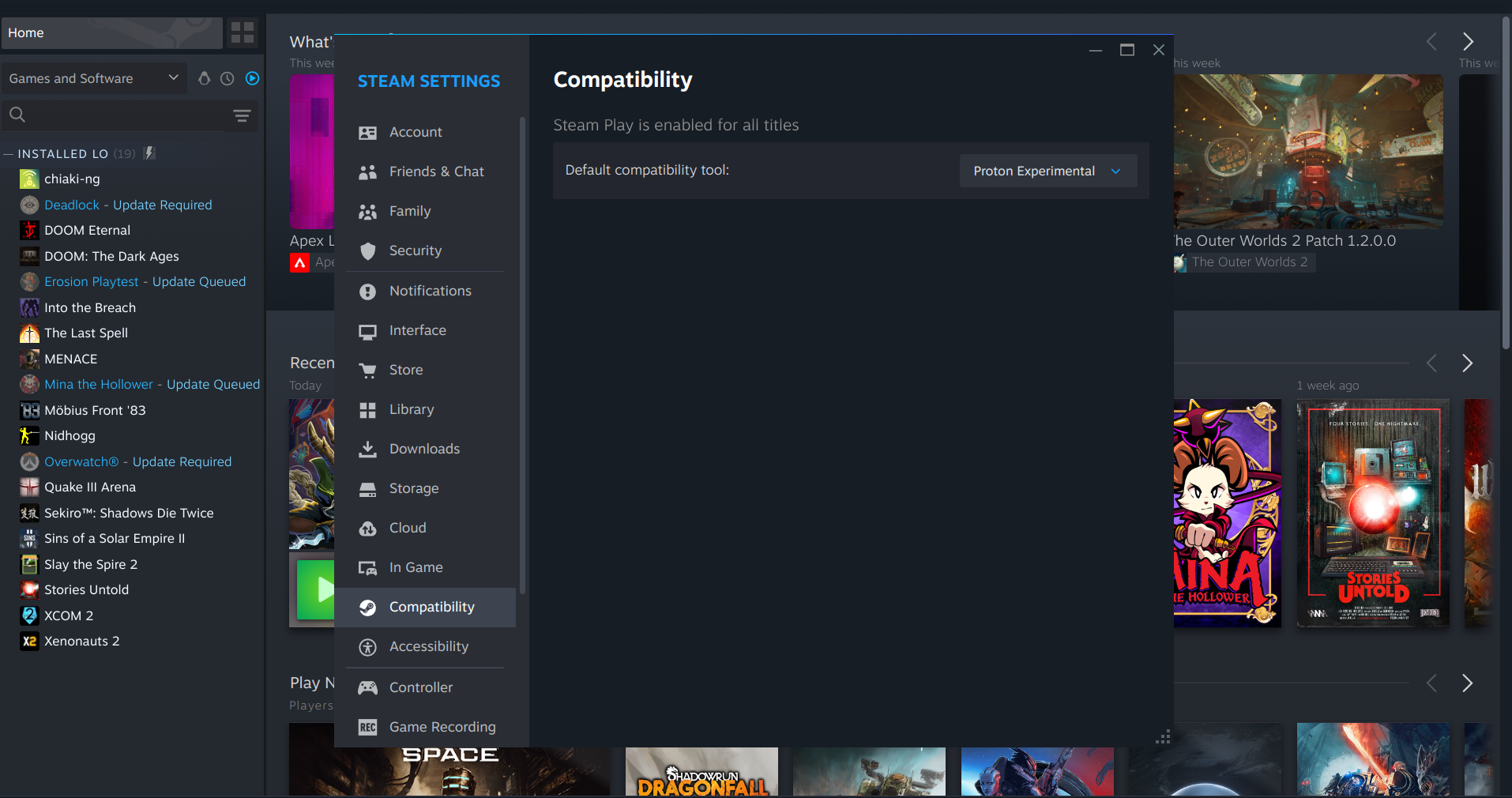
In 2005, when my then-roommate decided to install Linux on a contemporary student notebook, I was sceptical — and rightly so: almost nothing worked, no WiFi, no sound, let alone any cutting-edge Windows games from the time. The experiment was nuked a day later.
17 years later, Valve put a Linux gaming machine in my palms and the world changed. To be honest, they had already tried this in 2015 with the first and failed iteration of the Steam Machine, but the translation layer Proton that brings Windows games over was not ready until 2018.
Having replaced Windows in my work environment by moving to an M1 MacBook Pro in 2021, Windows still remained on my gaming PC. When the Steam Deck continuously improved to the point where you no longer questioned whether a game would just work — except for the odd anti-cheat-ridden online game — I was moving closer to trying a Linux distribution that was tuned for gaming.
When I learnt about Bazzite I was intrigued — building a Steam console with its Deck / HTPC image would be a great fit. PC gaming and especially Steam had always been my primary platform, although I have been a regular Xbox customer as well since the 360 days.
Moving to Linux would always have some very pragmatic requirements.
- Standby / sleep / wake-up should just work when a game is running
- Game performance similar to Windows
- HDR & VRR
My first attempt was to install Bazzite via dual boot on a Razer Blade laptop with an Intel / NVIDIA GPU combo. While setup was fine, there was an immediate showstopper: running games on an external display cut the framerate in half. After some research I found that this is a known issue with mobile NVIDIA GPUs. To this day, NVIDIA drivers on Linux perform worse and have more issues. AMD, on the other hand, was so close to Windows in terms of performance that the difference became negligible. One caveat: ray-tracing performance only just started to come closer to Windows with the same hardware. It was never a blocker for me since I usually disabled RT on Windows anyway. Still, the Linux project was put on ice again.
Fast forward to August 2025. Shortly before the RAM crisis started, I got the chance to get an all-AMD desktop PC with a Radeon RX 9070 GPU. I could always install Windows if things went wrong, so I went full Bazzite from day 1. Setup was, again, easy enough, and this time things looked different. This machine has been my primary gaming console attached to my living room TV, and it is still running the initial Bazzite installation. All the requirements mentioned above were fulfilled. That said, there are some caveats that are no showstoppers for me but should be mentioned:
- Waking the PC up with an Xbox Series controller did not work for me, even via the USB dongle. KB / mouse was fine and the new Steam Controller also worked after upgrading to the latest 44 release
- Multiplayer games that use certain anti-cheat technology will not work on Linux; please check areweanticheatyet.com.
- to use the latest tech available in Windows like AMD’s FSR4 Redstone you sometimes have to do some legwork
Bonus: CachyOS on a laptop
After my very own Steam machine was operational, I was ready to dive even deeper into Linux. The use case this time: find a very portable under-the-couch laptop. Again, I was very lucky to get hold of an all-AMD machine, this time an ASUS Zenbook 14 with a Ryzen AI 350.
Since I had heard good things about CachyOS, I gave it a shot. I have been running this for about 3 months and yet again I am very satisfied with the result. In fact, I am typing this blog post on this laptop. This time I went for the desktop edition — there is also a handheld variant available. The Radeon 860M GPU works fine for older games or even newer ones with lowered settings. Steam works right out of the box and they provide a custom Proton package that is pre-installed and maintained.
On the software side, CachyOS delivers. There is really a package for almost everything since it is Arch Linux under the hood. I even got an old Brother printer working because, of course, there is a package available. In general, CachyOS feels fast and bleeding-edge while also being extremely stable. In fact, I am even thinking about moving my Bazzite desktop over to CachyOS.
On the horizon
- Nvidia optimizations for DX12 games are coming to close the performance gap
- Epic Games seems to be looking at Linux Anti cheat which might be a good sign for the anti-cheat situation in general